
As this most disrupted of school years draws to a close, it is time to take stock of the impact of the pandemic on student learning and well-being. Although the 2020–21 academic year ended on a high note—with rising vaccination rates, outdoor in-person graduations, and access to at least some in-person learning for 98 percent of students—it was as a whole perhaps one of the most challenging for educators and students in our nation’s history.
Our analysis shows that the impact of the pandemic on K–12 student learning was significant, leaving students on average five months behind in mathematics and four months behind in reading by the end of the school year. The pandemic widened preexisting opportunity and achievement gaps, hitting historically disadvantaged students hardest. In math, students in majority Black schools ended the year with six months of unfinished learning, students in low-income schools with seven. High schoolers have become more likely to drop out of school, and high school seniors, especially those from low-income families, are less likely to go on to postsecondary education. And the crisis had an impact on not just academics but also the broader health and well-being of students, with more than 35 percent of parents very or extremely concerned about their children’s mental health.
The fallout from the pandemic threatens to depress this generation’s prospects and constrict their opportunities far into adulthood. The ripple effects may undermine their chances of attending college and ultimately finding a fulfilling job that enables them to support a family. Our analysis suggests that, unless steps are taken to address unfinished learning, today’s students may earn $49,000 to $61,000 less over their lifetime owing to the impact of the pandemic on their schooling. The impact on the US economy could amount to $128 billion to $188 billion every year as this cohort enters the workforce.
Federal funds are in place to help states and districts respond, though funding is only part of the answer. The deep-rooted challenges in our school systems predate the pandemic and have resisted many reform efforts. States and districts have a critical role to play in marshaling that funding into sustainable programs that improve student outcomes. They can ensure rigorous implementation of evidence-based initiatives, while also piloting and tracking the impact of innovative new approaches. Although it is too early to fully assess the effectiveness of postpandemic solutions to unfinished learning, the scope of action is already clear. The immediate imperative is to not only reopen schools and recover unfinished learning but also reimagine education systems for the long term. Across all of these priorities it will be critical to take a holistic approach, listening to students and parents and designing programs that meet academic and nonacademic needs alike.
As the 2020–21 school year began, just 40 percent of K–12 students were in districts that offered any in-person instruction. By the end of the year, more than 98 percent of students had access to some form of in-person learning, from the traditional five days a week to hybrid models. In the interim, districts oscillated among virtual, hybrid, and in-person learning as they balanced the need to keep students and staff safe with the need to provide an effective learning environment. Students faced multiple schedule changes, were assigned new teachers midyear, and struggled with glitchy internet connections and Zoom fatigue. This was a uniquely challenging year for teachers and students, and it is no surprise that it has left its mark—on student learning, and on student well-being.
As we analyze the cost of the pandemic, we use the term “unfinished learning” to capture the reality that students were not given the opportunity this year to complete all the learning they would have completed in a typical year. Some students who have disengaged from school altogether may have slipped backward, losing knowledge or skills they once had. The majority simply learned less than they would have in a typical year, but this is nonetheless important. Students who move on to the next grade unprepared are missing key building blocks of knowledge that are necessary for success, while students who repeat a year are much less likely to complete high school and move on to college. And it’s not just academic knowledge these students may miss out on. They are at risk of finishing school without the skills, behaviors, and mindsets to succeed in college or in the workforce. An accurate assessment of the depth and extent of unfinished learning will best enable districts and states to support students in catching up on the learning they missed and moving past the pandemic and into a successful future.
To assess student learning through the pandemic, we analyzed Curriculum Associates’ i-Ready in-school assessment results of more than 1.6 million elementary school students across more than 40 states. We compared students’ performance in the spring of 2021 with the performance of similar students prior to the pandemic. Students testing in 2021 were about ten points behind in math and nine points behind in reading, compared with matched students in previous years.
To get a sense of the magnitude of these gaps, we translated these differences in scores to a more intuitive measure—months of learning. Although there is no perfect way to make this translation, we can get a sense of how far students are behind by comparing the levels students attained this spring with the growth in learning that usually occurs from one grade level to the next. We found that this cohort of students is five months behind in math and four months behind in reading, compared with where we would expect them to be based on historical data.
Unfinished learning did not vary significantly across elementary grades. Despite reports that remote learning was more challenging for early elementary students, our results suggest the impact was just as meaningful for older elementary students. We can hypothesize that perhaps younger elementary students received more help from parents and older siblings, and that older elementary students were more likely to be struggling alone.
It is also worth remembering that our numbers capture the “average” progress by grade level. Especially in early reading, this average can conceal a wide range of outcomes. Another way of cutting the data looks instead at which students have dropped further behind grade levels. A recent report suggests that more first and second graders have ended this year two or more grade levels below expectations than in any previous year. Given the major strides children at this age typically make in mastering reading, and the critical importance of early reading for later academic success, this is of particular concern.
While all types of students experienced unfinished learning, some groups were disproportionately affected. Students of color and low-income students suffered most. Students in majority-Black schools ended the school year six months behind in both math and reading, while students in majority-white schools ended up just four months behind in math and three months behind in reading. Students in predominantly low-income schools and in urban locations also lost more learning during the pandemic than their peers in high-income rural and suburban schools (Exhibit 1).
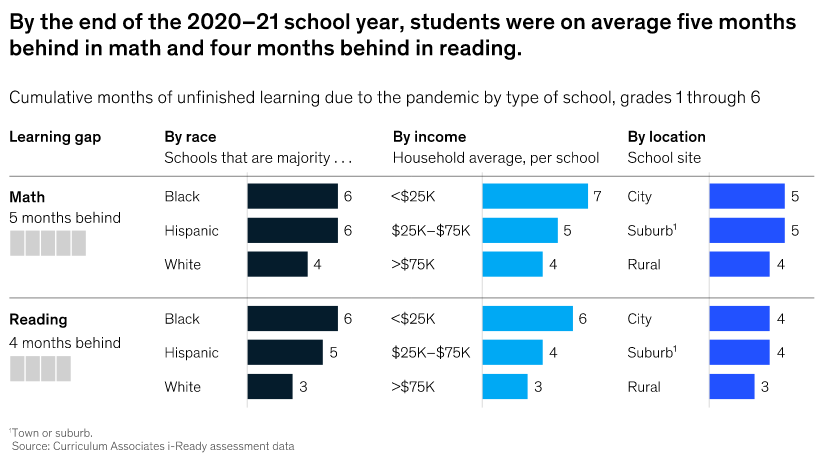
In fall 2020, we projected that students could lose as much as five to ten months of learning in mathematics, and about half of that in reading, by the end of the school year. Spring assessment results came in toward the lower end of these projections, suggesting that districts and states were able to improve the quality of remote and hybrid learning through the 2020–21 school year and bring more students back into classrooms.
Indeed, if we look at the data over time, some interesting patterns emerge. Taking math as an example, as schools closed their buildings in the spring of 2020, students fell behind rapidly, learning almost no new math content over the final few months of the 2019–20 school year. Over the summer, we assume that they experienced the typical “summer slide” in which students lose some of the academic knowledge and skills they had learned the year before. Then they resumed learning through the 2020–21 school year, but at a slower pace than usual, resulting in five months of unfinished learning by the end of the year (Exhibit 2).
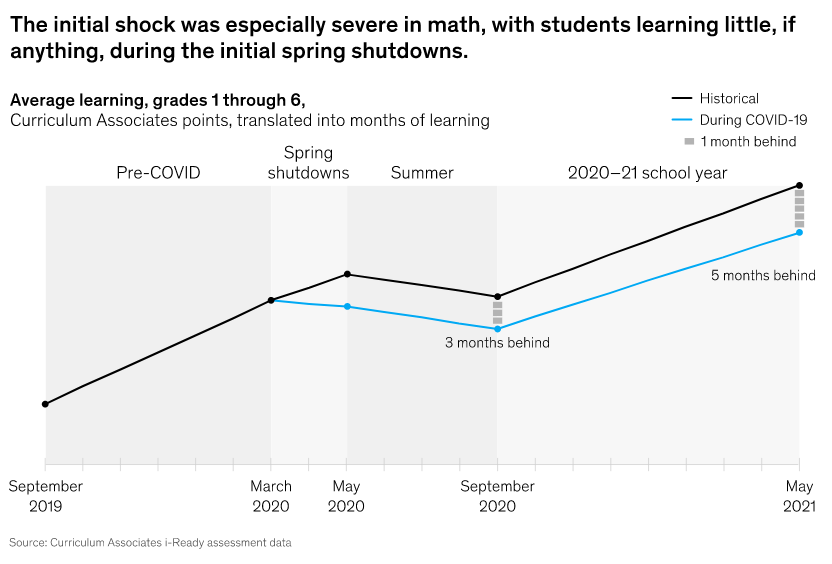
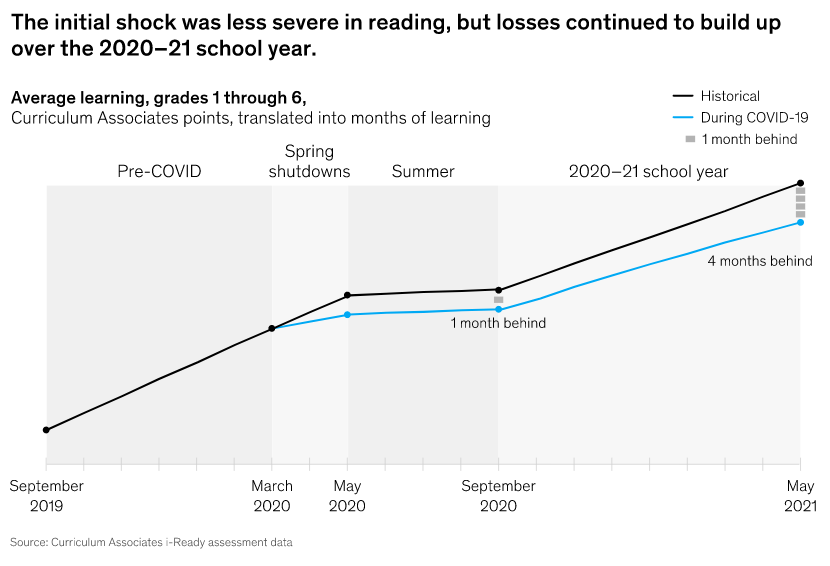
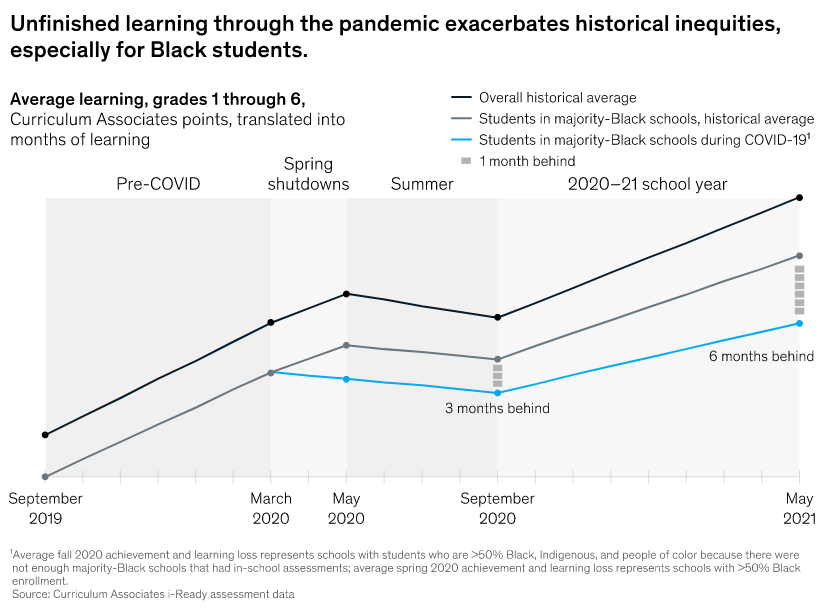
Furthermore, these results likely represent an optimistic scenario. They reflect outcomes for students who took interim assessments in the spring in a school building—and thus exclude students who remained remote throughout the entire school year, and who may have experienced the most disruption to their schooling. The Curriculum Associates data cover a broad variety of schools and states across the country, but are not fully representative, being overweighted for rural and southeastern states that were more likely to get students back into the classrooms this year. Finally, these data cover only elementary schools. They are silent on the academic impact of the pandemic for middle and high schoolers. However, data from school districts suggest that, even for older students, the pandemic has had a significant effect on learning.
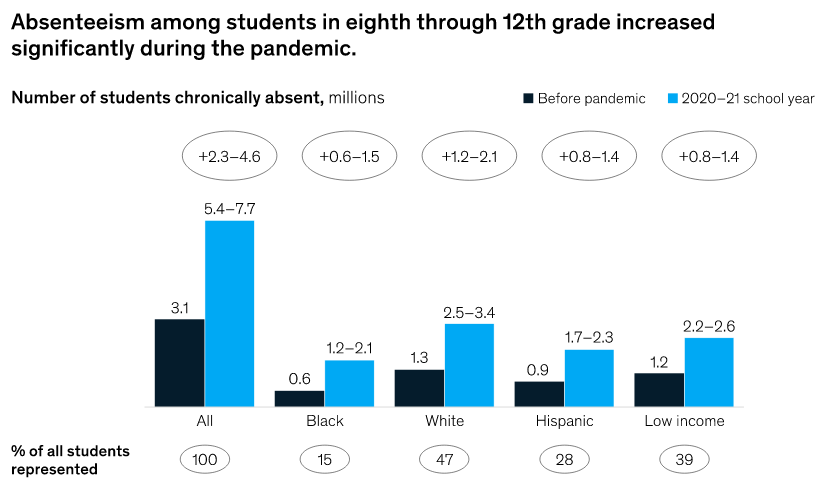
Students didn’t just lose academic learning during the pandemic. Some lost family members; others had caregivers who lost their jobs and sources of income; and almost all experienced social isolation.
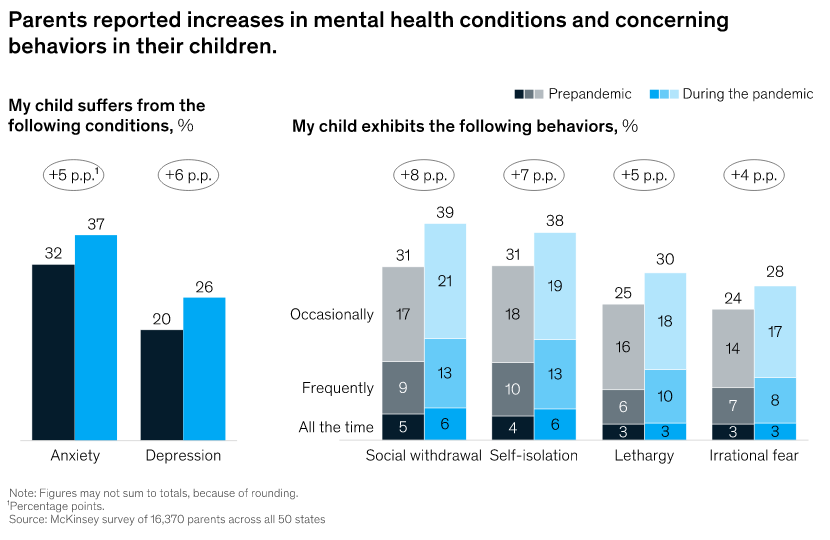
These pressures have taken a toll on students of all ages. In our recent survey of 16,370 parents across every state in America, 35 percent of parents said they were very or extremely concerned about their child’s mental health, with a similar proportion worried about their child’s social and emotional well-being. Roughly 80 percent of parents had some level of concern about their child’s mental health or social and emotional health and development since the pandemic began. Parental concerns about mental health span grade levels but are slightly lower for parents of early elementary school students.
Parents also report increases in clinical mental health conditions among their children, with a five-percentage-point increase in anxiety and a six-percentage-point increase in depression. They also report increases in behaviors such as social withdrawal, self-isolation, lethargy, and irrational fears (Exhibit 5). Despite increased levels of concern among parents, the amount of mental health assessment and testing done for children is 6.1 percent lower than it was in 2019—the steepest decline in assessment and testing rates of any age group.
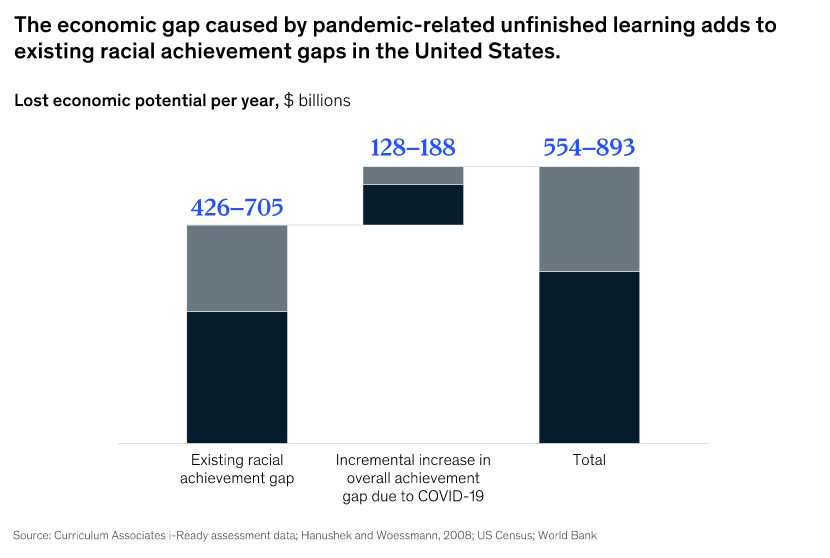
However, if this funding can mitigate the impact of unfinished learning, it could prevent much larger losses to the US economy. Given that this generation of students will likely spend 35 to 40 years in the workforce, the cumulative impact of COVID-19 unfinished learning over their lifetimes could far exceed the investments that are being made today.
Furthermore, much of today’s federal infusion will likely be spent not only on supporting students in catching up on the unfinished learning of the pandemic but also on tackling deeper historical opportunity and achievement gaps among students of different races and income levels.
As districts consider competing uses of funding, they are juggling multiple priorities over several time horizons. The ARP funding needs to be obligated by September 2023. This restricts how monies can be spent. Districts are balancing the desire to hire new personnel or start new programs with the risk of having to close programs because of lack of sustained funds in the future. Districts are also facing decisions about whether to run programs at the district level or to give more freedom to principals in allocating funds; about the balance between academics and broader student needs; about the extent to which funds should be targeted to students who have struggled most or spread evenly across all students; and about the balance between rolling out existing evidence-based programs and experimenting with innovative approaches.
These priorities encompass four potential actions for schools:
Across all of these actions, it is important for districts to understand the changing needs of parents and students as we emerge from the pandemic, and to engage with them to support students to learn and to thrive. The remainder of this article shares insights from our parent survey of more than 16,000 parents on these changing needs and perspectives, and highlights some early actions by states and districts to adapt to meet them.
The majority of school districts across the country are planning to offer traditional five-days-a-week in-person instruction in the fall, employing COVID-19-mitigation strategies such as staff and student vaccination drives, ongoing COVID-19 testing, mask mandates, and infrastructure updates. The evidence suggests that schools can reopen buildings safely with the right protocols in place, but health preparedness will likely remain critical as buildings reopen. Indeed, by the end of the school year, a significant subset of parents remain concerned about safety in schools, with nearly a third still very or extremely worried about the threat of COVID-19 to their child’s health. Parents also want districts to continue to invest in safety—39 percent say schools should invest in COVID-19 health and safety measures this fall.
Opening buildings safely is hard enough, but encouraging students to show up could be even more challenging. Some students will have dropped out of formal schooling entirely, and those who remain in school may be reluctant to return to physical classrooms. Our survey results suggest that 24 percent of parents are still not convinced they will choose in-person instruction for their children this fall. Within Black communities, that rises to 34 percent. But many of these parents are still open to persuasion. Only 4 percent of parents (and 6 percent of Black parents) say their children will definitely not return to fully in-person learning—which is not very different from the percentage of parents who choose to homeschool or pursue other alternative education options in a typical year. For students who choose to remain virtual, schools should make continual efforts to improve virtual learning models, based on lessons from the past year.
For parents who are still on the fence, school districts can work to understand their needs and provide effective learning options. Safety concerns remain the primary reason that parents remain hesitant about returning to the classroom; however, this is not the only driver. Some parents feel that remote learning has been a better learning environment for their child, while others have seen their child’s social-emotional and mental health improve at home.
Even if students reenroll in effective learning environments in the fall, many will be several months behind academically and may struggle to reintegrate into a traditional learning environment. School districts are therefore creating strategies to support students as they work to make up unfinished learning, and as they work through broader mental health issues and social reintegration. Again, getting parents and students to show up for these programs may be harder than districts expect.
Opportunity gaps have existed in our school systems for a long time. As schools build back from the pandemic, districts are also recommitting to providing an excellent education to every child. A potential starting point could be redoubling efforts to provide engaging, high-quality grade-level curriculum and instruction delivered by diverse and effective educators in every classroom, supported by effective assessments to inform instruction and support.
Beyond these foundational elements, districts may consider reimagining other aspects of the system. Parents may also be open to nontraditional models. Thirty-three percent of parents said that even when the pandemic is over, the ideal fit for their child would be something other than five days a week in a traditional brick-and-mortar school. Parents are considering hybrid models, remote learning, homeschooling, or learning hubs over the long term. Even if learning resumes mostly in the building, parents are open to the use of new technology to support teaching.
Edgecombe County Public Schools in North Carolina is planning to continue its use of learning hubs this fall to better meet student needs. In the district’s hub-and-spoke model, students will spend half of their time learning core content (the “hub”). For the other half they will engage in enrichment activities aligned to learning standards (the “spokes”). For elementary and middle school students, enrichment activities will involve interest-based projects in science and social studies; for high schoolers, activities could include exploring their passions through targeted English language arts and social studies projects or getting work experience—either paid or volunteer. The district is redeploying staff and leveraging community-based partnerships to enable these smaller-group activities with trusted adults who mirror the demographics of the students.
In Tennessee, the new Advanced Placement (AP) Access for All program will provide students across the state with access to AP courses, virtually. The goal is to eliminate financial barriers and help students take AP courses that aren’t currently offered at their home high school.
The Dallas Independent School District is rethinking the traditional school year, gathering input from families, teachers, and school staff to ensure that school communities are ready for the plunge. More than 40 schools have opted to add five additional intercession weeks to the year to provide targeted academics and enrichment activities. A smaller group of schools will add 23 days to the school year to increase time for student learning and teacher planning and collaboration.
It is unclear whether all these experiments will succeed, and school districts should monitor them closely to ensure they can scale successful programs and sunset unsuccessful ones. However, we have learned in the pandemic that some of the innovations born of necessity met some families’ needs better. Continued experimentation and fine-tuning could bring the best of traditional and new approaches together.
Thanks to concerted efforts by states and districts, the worst projections for learning outcomes this past year have not materialized for most students. However, students are still far behind where they need to be, especially those from historically marginalized groups. Left unchecked, unfinished learning could have severe consequences for students’ opportunities and prospects. In the long term, it could exact a heavy toll on the economy. It is not too late to mitigate these threats, and funding is now in place. Districts and states now have the opportunity to spend that money effectively to support our nation’s students.
Our Mission:
The mission of Academic Boost is devotion to providing the highest quality of educational assistance given with patience, gentleness, and positivity.
Our Vision:
We want every individual we serve to gain knowledge, excel, and succeed in all areas.
Academic Boost LLC © 2022. All Rights Reserved.